
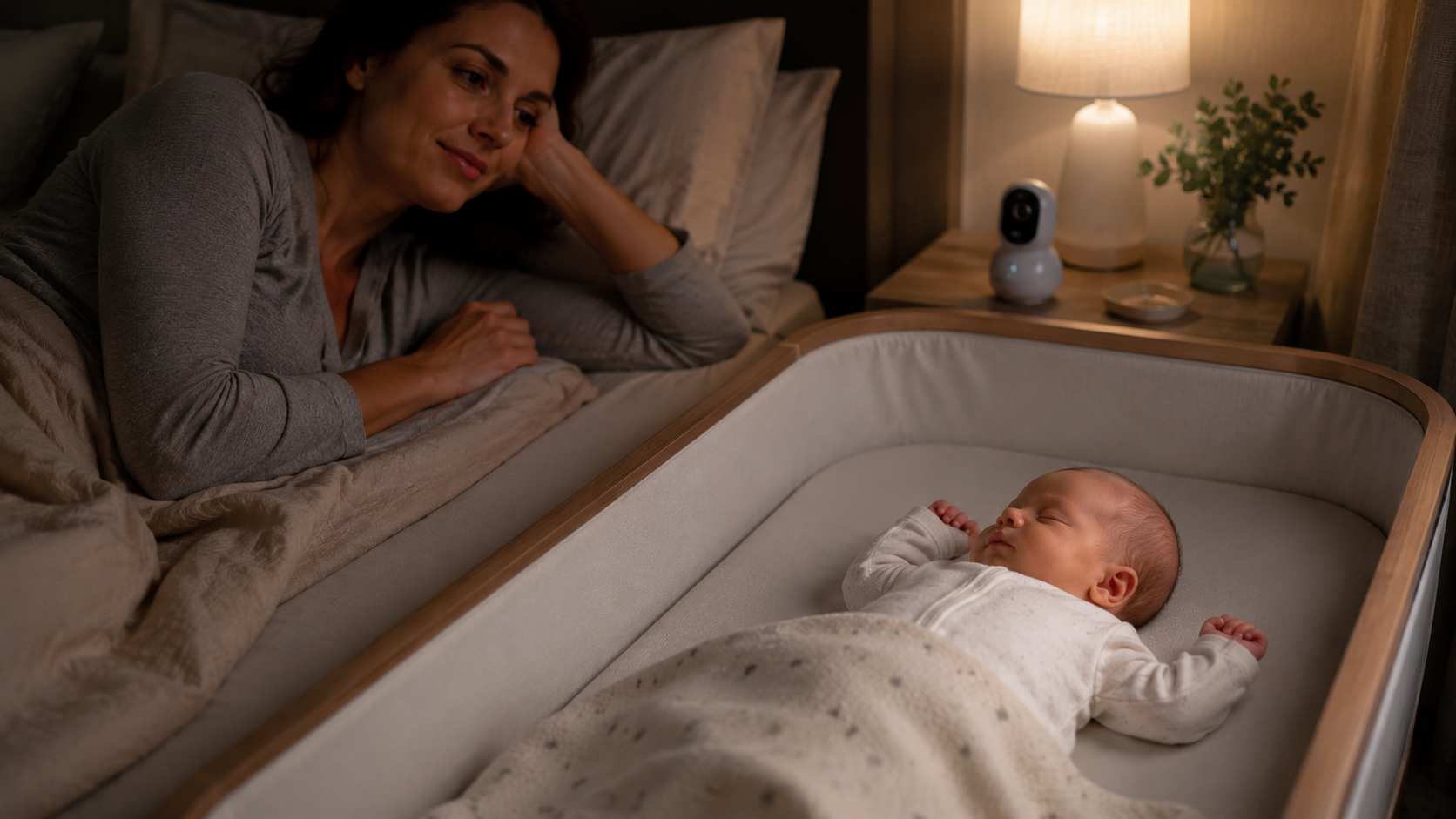
Safer sleep is the single most protective thing there is to get right in the first months, and the guidance is short enough to remember. On their back, in their own clear flat sleep space, in your room for the first six months, in a smoke-free environment, and not too warm.
On the back, every sleep
Put your baby on their back for every sleep, night and day, from birth. This one change, promoted from the early nineties, is associated with a very large fall in sudden infant death across the countries that adopted it.
Side sleeping is not a safe alternative, because babies can roll onto their front from it. Once a baby can roll both ways reliably on their own, usually somewhere around five or six months, you do not need to keep returning them to their back through the night, but you should still start them there.
Babies do not choke from sleeping on their back. The anatomy protects the airway, and this concern, though common, is not supported by evidence.
Their own clear, flat space
A cot, crib or Moses basket in your room, with a firm, flat, waterproof mattress in good condition and a fitted sheet.
Keep it clear. No pillows, duvets, cot bumpers, pods, nests, sleep positioners or soft toys. Loose bedding and soft objects are a suffocation risk, and products sold to make a cot cosier are frequently not compliant with safer sleep advice however they are marketed. Use a lightweight, well-fitting blanket tucked in no higher than the shoulders, or a baby sleeping bag of the right size.
Feet-to-foot means placing your baby with their feet at the end of the cot so they cannot wriggle under the covers.
In your room for six months
Have your baby sleep in the same room as you, in their own separate sleep space, for at least the first six months, including for daytime naps. Room sharing is associated with reduced risk, and it makes feeding at night considerably easier.
Never in these situations
Never sleep with your baby on a sofa or armchair. This carries a very high risk, considerably higher than sharing a bed, because babies can slip into a gap or become trapped against the cushions or against you. If you are feeding at night and feel you might fall asleep, move to a bed first, where it is safer if sleep takes you by surprise.
Never share a bed with your baby if you or your partner smoke, have drunk alcohol, have taken drugs including medication that makes you drowsy, or are unusually tired. Bed sharing is also not advised if your baby was born prematurely or with a low birth weight.
Many parents end up bed sharing at some point, planned or otherwise, and being honest about that is more useful than pretending. If you do, keep pillows and covers away from the baby, make sure they cannot fall or become trapped between the mattress and a wall, and never let anyone else share the bed with them.
Temperature and smoke
Overheating raises risk. Keep the room between roughly sixteen and twenty degrees, use lightweight bedding, and check the chest or back of the neck rather than hands and feet, which are normally cooler. Never cover a pram with a blanket or muslin, which traps heat quickly.
Keep your baby's head uncovered indoors and remove hats and outdoor coats once inside or in the car.
A smoke-free environment matters a great deal, before and after birth, and includes anyone else who smokes in the home. Support to stop is free through the NHS.
What also helps
Breastfeeding is associated with reduced risk, and any amount helps. Using a dummy for sleeps, once feeding is established, is also associated with lower risk, though there is no need to force it or to replace it once it falls out.
When to get help
Trust your instincts if your baby seems unwell. Contact 111 or your GP if you are worried, and call 999 for a baby who is very hard to wake, is having difficulty breathing, has blue or very pale skin, or has a rash that does not fade under a glass.
This is general information following current UK safer sleep guidance rather than a substitute for your midwife or health visitor.